For 17 years I have planned journeys for people who cannot afford to get stuck. This year several things have come together in Europe at once: new border systems, border checks where there had been none for 20 years, and strikes announced months in advance. Here is what has really changed, and how I now plan trips around it.
The most common call this summer
When my phone rings in summer, the call doesn't start with the word “attack”. It starts with “We're at the border and nothing's moving.” Or “Our flight's been cancelled and the client is waiting for us in Prague.”
That is travel risk management today. Nine out of ten problems I deal with are not attacks. They are queues, closures, strikes and missing paperwork. They all have one thing in common: they can be predicted. And almost always, someone announced them in advance.
Borders really have changed this year
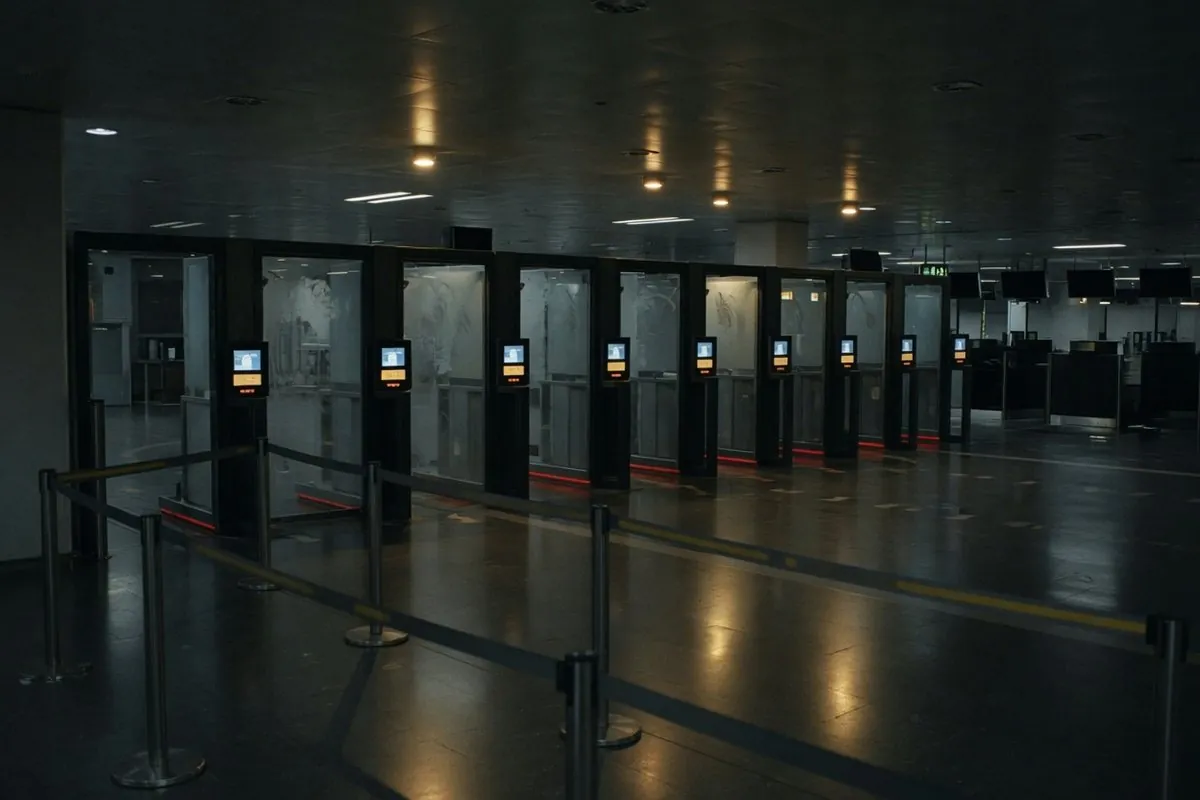
Since 10 April 2026, the EU's Entry/Exit System (EES) has been fully operational. Phased in from October 2025, it now runs at every external Schengen border. It applies to third-country nationals coming for a short stay, so if you hold a Czech passport it does not apply to you. It does, however, apply to your guests and partners from outside the EU, and to employees who do not hold an EU residence permit or long-stay visa.
At the first crossing, travellers have their face scanned and their fingerprints taken, and passports are no longer stamped. On later trips the biometrics are simply checked, which is quicker. The problem is that first crossing.
On 1 July the aviation industry sent the European Commission an open letter citing waiting times of up to five hours at peak times. The Commission counters that serious queues affect about 20 of some 1,500 border crossing points. Prague reports that checks now take tens of seconds longer per passenger. With a thousand people in the queue, those seconds add up.
What I do about it: for guests from outside the EU arriving in Schengen for the first time, I build in an extra hour, and I never book them a tight connection.
ETIAS: still nothing, and that tells you something
ETIAS is not operational and, as of today, has no published launch date. The official ETIAS website and the Commission's pages both state that applications are not being accepted. As recently as April the talk was of the last quarter of 2026; today the main pages give no date at all. According to a Financial Times report, the eu-LISA agency has internally pushed the launch back to 2027. Nobody has confirmed this officially.
The fee and the conditions are set out in the EU regulation itself. An authorisation will be valid for three years or until the passport expires.
The practical upshot: if anyone offers to “arrange your ETIAS” today, it is a scam. The system does not exist yet.
The trap for frequent travellers: the 90/180 rule
A short stay means no more than 90 days in any 180-day period, and the days are added up across all the countries that use EES, not country by country. The system now tracks this automatically.
This is the detail that can catch you out this year. The EU's official calculator explicitly does not count any stay that began before 10 April 2026. And until 6 October 2026, an “OK” result may be unreliable for holders of single- and double-entry visas who used one of those entries between October 2025 and April 2026.
In other words, this year the calculator may tell you all is well when you have actually clocked up more days than it shows. For foreign colleagues, I am keeping my own record of their stays this year until things settle down.
Internal border checks, including on the Czech border
Most people underestimate this, because “surely nobody checks you inside Schengen”. They do. According to the Commission's official list as of 28 July 2026, temporary checks are in place in the countries below; check the current position in that list before you travel:
- Germany, from 16 March to 15 September 2026, including its land border with the Czech Republic
- Austria, from 16 June to 15 September 2026, again including the border with the Czech Republic
- France, from 1 May to 31 October 2026, at all internal borders, partly because of the G7 summit in Évian
- The Netherlands, Italy, Sweden and Norway, each under its own arrangements
- Poland has checks, but not on its border with the Czech Republic
Update, 29 September 2026: Germany and Austria have extended their checks, including on their borders with the Czech Republic, from 16 September 2026 to 15 March 2027 (the European Commission's current list).
So a transfer from Prague to Munich or Vienna can now end with you stuck at the border. Everyone must carry their own valid ID card or passport, children included; a child entered in a parent's document cannot travel on it.
Prague through the eyes of someone who keeps watch over it
I'll start with the good news, because you rarely hear it. Crime in Prague is falling. In 2025, 34,853 offences were recorded, 9.3% fewer than the year before, and the clearance rate is approaching 27%. In the first quarter of 2026 crime fell by a further 2%, and burglaries dropped markedly.
There is one exception, though: violent crime rose in the first quarter of 2026, from 449 to 513 cases. That is a figure I am watching.
Pickpocketing and theft from the person accounted for 8.5% of all crime in Prague last year. The UK Foreign Office names specific places in its travel advice: metro and bus routes from the airport into the centre and trams heading to Prague Castle. For the summer, Prague police are reinforcing their specialist pickpocket teams and bringing in officers from abroad, because this kind of crime is often the work of organised groups.
What strikes me most in the Prague figures is taxis. Prague City Hall carried out 1,470 inspections last year and found breaches of the law in 314 cases. For private hire, breaches were found in 71% of inspections. Since September 2024, 46 drivers have been handed over to the Foreign Police, and 16 people have been charged with issuing unauthorised licences to foreign drivers in as many as 200 cases. That is why I always book clients' transfers in advance, and never flag down a car in the street.
Three more things come up again and again in Prague, and each has a clear answer:
- Bureaux de change. For certain transactions, the law gives you the right to cancel within a short period at the same branch, subject to conditions. Always take a receipt, check the posted exchange rates and never change money in the street.
- Fake police officers. They stop you in the street and ask to “check” your cash or foreign currency. Only fraudsters ask for this; a real police officer has no power to do so. A genuine officer can ask you to prove your identity. If that happens, ask to see their police ID and suggest sorting the matter out at the police station.
- Bars and clubs. Check your bill, and watch out for “cards” that carry a steep charge if you lose them. In a Czech survey of 1,041 people, a third said they had personal experience of drink spiking. Never leave a drink unattended.
And cars. In 2024, 2,801 vehicles were stolen in the Czech Republic, 637 of them in Prague. More interesting is the change in method. In 2010, 80% of thefts involved a visible break-in; today the figure is just 30%. The rest involve jammers, key emulators and tampering with the car's internal communications. A broken window is no longer the tell-tale sign of a stolen car.
Europe: what disrupts travel most often today
Air travel is running at the limit. In mid-July 2026 more than 36,000 flights a day were operating across Europe, yet arrival punctuality was 69% and departure punctuality 63%. Weather causes most of the delays: it accounted for 55% of all en-route delays in summer 2026. On top of that, flights can still use only about 80% of the airspace that was available before Russia's invasion of Ukraine.
The system is so stretched that a single technical fault can throw it off balance. When the slot-allocation system in Brussels failed on 27 July, a contingency plan had to be activated and delays ran into the following day. In January, radio frequencies went down across the whole of Greek airspace, grounding around 120 flights.
Then there are drones. Munich and Copenhagen have both had to restrict operations temporarily because of drone sightings. The European Commission has responded with a counter-drone action plan, but it is not expected to be fully operational until the end of 2027.
And then there are the things we know about in advance. These are the ones you can build into a travel plan most reliably:
- The French air traffic controllers' union has called a four-day nationwide strike for 7–10 October 2026. Ryanair has warned it may cancel up to 1,800 flights.
- In Italy, a full-day strike by airport security staff at Rome Fiumicino and Ciampino has been announced for 13 September 2026, and a four-hour air traffic control strike for 30 September.
- Belgium has already had two general strikes this year. The one in May wiped out roughly half of the 650 departures scheduled from Brussels.
If someone tells me now that they want to fly through France in the first half of October, it is already in my diary.
Two more issues get little coverage. The first is satellite signal jamming and spoofing: on 3 July EASA issued the fourth revision of its bulletin, and the affected areas are the Baltic and Black Seas, the Mediterranean, the Middle East and the Arctic. The second is cyber: in September 2025, ransomware at a check-in software supplier knocked out systems at airports in London, Brussels, Berlin and Dublin, and passengers were checked in with pen and paper.
Terrorism threat levels have gone up across Europe this year. The UK has been at severe since 1 May, Germany raised its assessment to “high” in mid-July, Belgium is holding at level three of four and France has stepped up its vigilance. In the Czech Republic, level B (moderate threat) applies for the whole of 2026, the second lowest of four levels.
Luxury watches: a visible target
This is crime aimed directly at our clients. According to The Watch Register's database, more than 10,000 luxury watches were reported stolen or lost worldwide last year, an average of one every hour. London, Barcelona and Ibiza are named as the highest-risk places in Europe, followed by Paris, Milan and Rome.
In Milan, street robberies of watches rose by 30%, and the recorded cases included Richard Mille and Audemars Piguet pieces. In Paris, a masked robber on a scooter made off with 11 Rolex watches from a shop.
London shows it can work the other way. After targeted policing, pickpocketing fell by 23% in a year and phone theft in the West End halved.
One more trick worth remembering. In Madrid, a man was arrested and accused of 15 hotel-room burglaries. There was nothing technically sophisticated about it: he watched guests checking in, memorised their names and room numbers, then asked reception for a replacement key card, saying he had lost the original. That is why I never say my name or room number out loud at reception.

Duty of care is not a policy to leave in a drawer
If you send staff on business trips, this is the section that matters most to you.
There is an international standard for travel risk management: ISO 31030. You cannot be certified against it; it is guidance, not a stamp. But that is precisely what makes it dangerous. It can be expected to be cited in court as the benchmark for whether a company has met its duty of care.
Czech law is straightforward here. The Labour Code requires employers to ensure safety with regard to the risks involved (§101), to identify and assess risks on an ongoing basis, keep records of it and have measures ready for emergencies, including evacuation (§102), and to inform and train employees about the risks in a way they understand (§103). Liability for a workplace injury is strict: nothing has to have been breached, and the employer can escape it only in the limited cases set out in the Labour Code (§270).
The Labour Inspectorate's figures show this is not just theory. In the first half of 2025 alone it carried out thousands of inspections and found breaches in roughly 60% of them. In extreme cases, breaching an important duty arising from employment can become a criminal matter.
There is also a European precedent. In 2015, a court in Oslo awarded compensation to an employee of the Norwegian Refugee Council who had been shot and kidnapped on a work trip to Kenya. The court found the organisation grossly negligent because the kidnapping risk was foreseeable, available measures had not been taken and the decision-makers did not understand the situation well enough.
Even so, only a minority of companies have a formal travel risk management programme. In one international survey of senior management, just 24% of organisations reported a strong programme in line with ISO 31030.
What your travel insurance doesn't cover
Read this section even if you skip the rest. I went through the policy terms of one of the major Czech insurers as a typical example (the others tend to be similar), and this is how it stands:
- War and civil unrest: excluded entirely, including invasion, uprising and revolution.
- Terrorism: cover may be excluded if you travel to an area despite an official warning, and limits on medical expenses vary from policy to policy. Check the exact wording before you travel.
- Kidnap and ransom: not covered at all. In the entire 60-page document, the words “kidnapping”, “ransom” and “hostage” do not appear once.
Anyone who needs this cover needs separate K&R insurance, and it has one peculiarity: a confidentiality clause. Its existence must not be discussed within the company, or it ceases to be valid. Only a handful of people know it exists. Paying a ransom is a legal minefield in itself, because sanctions regimes can prohibit both the payment and any contact with certain groups.
What I do before a trip, during it and if something goes wrong
There is no magic to it, just a sequence of steps that has proved itself:
- Before the trip. I check the Commission's official list for any border checks along the route. I verify every traveller's documents, including the children's. For guests from outside the EU, I go through their EES records and how many days of stay they have left. I book the transfer in advance. I add any announced strikes and closures to the plan. And I agree a communication plan: who contacts whom and when, and what happens if someone fails to check in.
- During the trip. Keep a low profile. Watches and other visible valuables have no place on the airport transfer. Don't say your name or room number out loud at reception. Don't leave a drink unattended. Change money only at a bureau de change. Offer a fake police officer a trip to the station.
- If something happens. Call 112, the emergency number. Report a theft to the police as soon as possible, ideally within 24 hours, as insurers usually require a police report; in Prague there is a police station open around the clock at Jungmannovo náměstí 9. Above all, pick up the phone before you start trying to sort it out yourself. Most of the damage is done not in the first minute but in the 30 that follow.
Why I'm writing about this now
One international survey this year found that three-quarters of companies feel the window for critical decisions is narrowing, yet only a third believe they can respond quickly. The gap between “we know about it” and “we can actually do something about it” is exactly where our work happens.
Most of what I have described here could have been found out in advance. The strike was announced, the border check is on the official list, the engineering works are in the timetable and the insurance exclusion is in the policy terms. It is just that nobody read them in time.
If you are planning travel for yourself, your family or your staff, get in touch with me for a no-obligation consultation. We will go through the specific route and dates and tell you plainly what is really needed and what is simply scaremongering. No pressure, no commitment.
“Risk on the road rarely announces itself in advance. Strikes, closures and border checks do, and that is exactly the part you can plan for.”— Robert Václavík
Correct as of 28 July 2026. Dates of strikes, closures and border checks change, so please verify them before you travel. Announced strikes can be called off, and internal border checks are being both extended and lifted. The European Commission keeps the current list of checks, and the Czech Ministry of Foreign Affairs issues travel advice. This article is general information, not legal or insurance advice.