What a professional TSCM sweep actually looks for, why a cheap “bug detector” is not enough and why even a room swept clean does not stay secure indefinitely.
Eavesdropping is often pictured as a simple equation: a device transmits, a detector picks up the signal and the problem is solved. But a modern office produces so many legitimate signals, and a technical threat can take so many forms, that a beep without context tells you surprisingly little.
An illustrative scenarioA confidential business meeting is held in a boardroom. A few days later, there are reasonable grounds to suspect that information known only to a handful of those present has got out. Someone buys a basic RF detector, switches it on by the table and it starts to beep.
But all around it, Wi‑Fi, Bluetooth, mobile phones, wireless peripherals, conferencing equipment and sensors are already at work. So what exactly does the beep prove? On its own, very little.

The second question matters even more: if the detector stays completely silent, does that mean the room is clean? Again, no.
01TSCM is not a single instrument
TSCM stands for Technical Surveillance Countermeasures. NIST defines the term as techniques used to detect and neutralise technical surveillance that enables unauthorised access to, or removal of, information.[1] For a client, though, a more practical explanation helps: TSCM is a structured search for unusual technical and physical indicators in a space where sensitive information could leak.
A single instrument can provide one layer of observation. A professional conclusion only emerges when several layers are combined: what is normally in the room, who has had access to it, what has changed, how the technical environment behaves and whether what has been observed is consistent with legitimate use.
That is why a sweep does not start by switching on a detector. It starts with questions: what information is discussed in the space, who the realistic adversary is, how long the client has had control of the room, who services it and which systems are a normal part of it. Without that context, even high-quality measurements can turn into a long list of meaningless signals.
02Not everything has to be transmitting
The popular idea of a “bug” is often limited to a microphone that continuously sends audio to someone outside the room. That is only one possible category. A technical threat may communicate actively, store data locally, record images, track location or make use of existing infrastructure. The risk may also be an ordinary device that has been compromised, or configured differently from what its owner expects.
Actively communicating devicesTransmit data or connect to another system.Local recordingStores information and may send nothing at the time of the check.Covert imaging equipmentTargets images, documents or movement in the space.Location-tracking devicesTied to the movement of people, vehicles or objects.Infrastructure connectionsUse cabling, the power supply, the network or conferencing systems.Compromised everyday technologyA phone, computer, smart device or peripheral becomes the route by which information leaks.This is the fundamental reason why “silence” cannot be equated with security. A device that is not communicating at that moment may produce no noticeable radio signature. A device connected to legitimate infrastructure may, at first glance, look like an ordinary part of it. A professional sweep therefore looks for more than a transmitter. It looks for discrepancies between the expected state and the actual state.
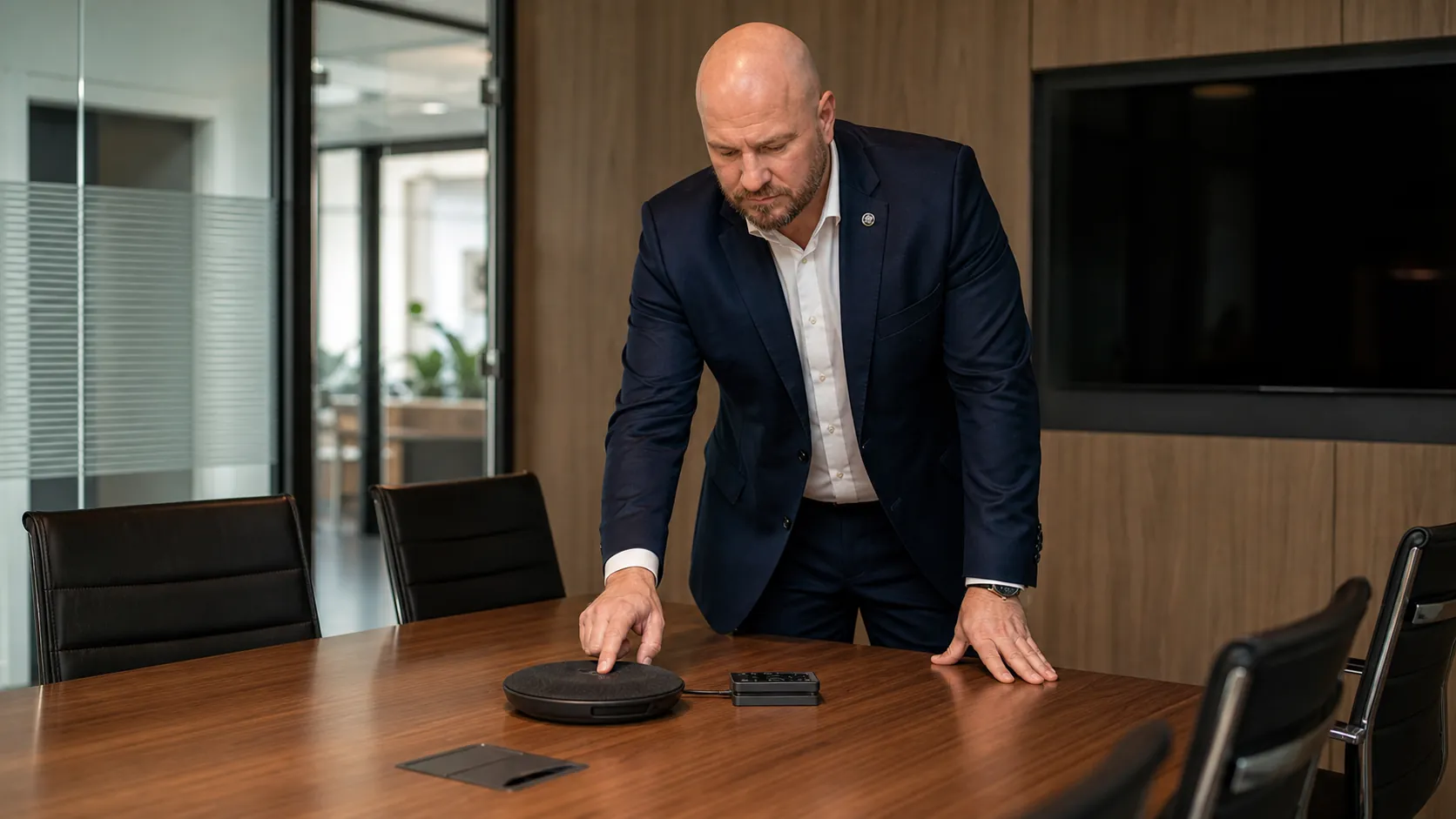
03Why a cheap “bug detector” is not enough
A basic RF detector usually reacts to the presence of radio-frequency energy, and a modern office is full of it for entirely legitimate reasons. Phones, access points, wireless mice, headsets, smart sensors and other connected devices create an environment in which detecting energy alone does not tell you whether there is a threat. NIST, after all, defines an Internet of Things device precisely as the combination of a sensor or actuator with a network interface such as Ethernet, Wi‑Fi or Bluetooth.[4]
A consumer device can therefore tell you that something is happening in a particular spot. What it lacks is the context to establish reliably what it has picked up, whether that is normal, whether the signal belongs to the space being checked and whether it has anything to do with the client’s concern. The result is often a string of false alarms or, conversely, reassurance based solely on the fact that the device registered nothing obvious.
That does not make an inexpensive detector worthless. It can serve as a rough guide or as the first prompt to seek a professional assessment. It is not, however, a substitute for professional TSCM, and it should not be treated as a certificate that a room is secure.
04What a professional TSCM sweep brings together
The scope is set according to the risk, the space and the purpose of the check. UK NACE, the UK’s National Authority for Counter-Eavesdropping, describes TSCM as a combination of physical security, people and procedures, physical search, technical anomaly detection and subsequent reporting.[2] That captures the essence well: a professional sweep is not a contest to own the most expensive instrument but methodical work drawing on several sources of evidence.
In broad terms, it usually includes preparation and risk assessment, a physical search of the environment, a review of the technical context, analysis of the radio-frequency environment, an optical inspection where relevant and checks on selected parts of the infrastructure. Every unusual finding is documented and assessed according to where it was found, how it fits normal operations and whether there is a legitimate explanation for it.
It is the physical element that the public tends to underestimate. An altered object, an unexpected connection, signs of tampering or a discrepancy in the inventory can matter as much as a reading on a display. Equipment shows a phenomenon; the sweep has to explain what it means.
05A false sense of security is also a risk
An honest security provider should not sell a client absolute certainty. A TSCM sweep can systematically check a defined space at a given time and describe what it found. It cannot promise that the environment will never change.
An hour later, maintenance staff, cleaners, caterers or another visitor may come in. A new monitor, conference unit or charger appears. Something is moved, replaced or comes back from repair. It therefore makes sense to plan not only the sweep itself but also the arrangements that follow it: who may enter the space, whether it remains supervised, how changes are recorded and what happens if unplanned work becomes necessary.
Alongside one-off inspections, UK NACE separately describes the continuous monitoring of sensitive spaces.[3] British government guidance for the most sensitive environments follows the same logic: for the relevant meeting spaces, it sets out periodic TSCM sweeps and, where needed, checks on items newly brought into them.[10] This is not a universal standard for every commercial office, but it illustrates the principle precisely: security is a condition that depends on time, access and changes to the environment.
“Clean” is not a permanent property of a room. It is the result of a check that holds true for a precisely defined moment and set of conditions.
06A hotel room is not the same as a boardroom
Every environment has its own access history, technical infrastructure and risk profile. A hotel suite sees a constant turnover of guests, staff, maintenance teams and external contractors. The client usually has no long-term control over it and often enters it only shortly before a sensitive stay.
An office may have a better-understood access regime, but it is often more complex technically: the corporate network, access control, videoconferencing, smart building management and a large number of legitimate devices. A boardroom concentrates decisions and information into short windows of time, so the risk may not be constant but can rise sharply ahead of a particular meeting.
A private residence is a long-term ecosystem used by members of the household, staff and service companies. A vehicle is regularly on the move, is parked outside controlled areas and goes in for servicing. A venue ahead of a major event changes by the hour as production crews, equipment and suppliers arrive. The same checklist therefore cannot be carried over mechanically from one context to another.
Practical checklistWhen to consider a TSCM sweep
- Before a major business negotiation, merger, acquisition or board meeting.
- When there are reasonable grounds to suspect that information known only to a small circle of people has leaked.
- After a change in who controls a sensitive space, a move or a major refurbishment.
- After maintenance work or the installation of new equipment, where the risk profile warrants it.
- Before a high-profile client arrives at a hotel suite, residence or office.
- For sensitive legal, political or diplomatic discussions.
- As a proportionate periodic check for spaces exposed to high risk over the long term.
07What if something really is found
An unusual object or technical phenomenon is not automatically proof of deliberate eavesdropping. It may be a legitimate part of a system, a forgotten device, a faulty installation or a genuinely unauthorised item. The first professional response is therefore to check the context, not to sensationalise.
The finding is documented, unnecessary handling is avoided and the next steps are decided according to the situation. If an item may have evidential value, it is important to protect its integrity and keep a traceable record of who has handled it. NIST stresses that evidence management should prevent evidence from being compromised, contaminated or degraded, and should maintain the chain of custody.[9]
Depending on the circumstances, company management, legal counsel, internal security, an IT specialist or law enforcement may be brought in. Whether an item is disconnected, left in place or professionally secured should not be decided on impulse. The right course of action depends on the risk, the legal framework and the aim of any further investigation.
08TSCM is not a substitute for cyber security
If information is leaking through a compromised email account, phone or cloud account, badly configured permissions or a person with legitimate access, a perfectly swept boardroom will not solve the problem. The NCSC points out that peripherals and wireless interfaces can open up additional routes to devices and data;[5] CISA, for its part, bases insider-threat mitigation on bringing together physical security, workforce awareness and information protection.[7]
Protecting a confidential meeting therefore requires four disciplines working together:
CISA describes integrating security disciplines as a route to a more complete strategy, and the NIST Cybersecurity Framework covers the entire risk-management cycle, from governance and identification through protection and detection to response and recovery.[6][8] TSCM is an important layer in that system, not the whole system.
09When TSCM makes sense
TSCM is proportionate where the value of the information, the profile of the person or a specific suspicion is significant enough. Typical cases include mergers and acquisitions, sensitive legal discussions, management meetings, a stay by a public figure, the protection of a family with high privacy expectations, a significant political or diplomatic visit, or a well-founded suspicion that privacy has been breached.
It is not a service that every person, every office or every routine meeting automatically needs. Security measures should be proportionate to the risk. Excessive checking with no specific purpose can be costly and disruptive and, paradoxically, can draw attention away from more likely ways for information to leak.
So the right question is not “could something happen?”, because zero risk does not exist. It is this: how valuable is the information, who might want it, what capabilities do they have and what level of control is reasonable in response?
10The biggest mistake: treating “we found nothing” as a permanent state
A good TSCM report should not say: “This room is permanently secure.” That statement cannot be defended professionally. A precise report defines the space, the time, the scope, any anomalies observed, the inspection framework used and the relevant limitations.
A more accurate wording would be:At a defined time, we systematically checked a defined space, assessed the technical and physical findings available to us and described the condition that could be verified during that check.
“We found nothing” is therefore not an empty result. It can mean that, within that scope, nothing was identified that requires further action. But it is not a promise about the future. A responsible conclusion links the result of the sweep to recommendations on how to protect the space afterwards, who may enter it and when it makes sense to repeat the check.
It is precisely this restraint that separates a professional security service from simply selling a feeling of safety. The aim is neither to frighten the client nor to offer absolute certainty. It is to give the most accurate picture possible and to reduce the risk to a reasonable degree.
Frequently asked questions
What does TSCM stand for?
Technical Surveillance Countermeasures. It is a systematic technical and physical inspection designed to identify anomalies and risks that could allow unauthorised access to sensitive information.
Can a sweep find every listening device?
No honest provider can promise to detect every possible device in every circumstance. A professional sweep significantly increases the likelihood of identifying relevant anomalies by combining several methods and assessing the results in context.
How long does a TSCM sweep take?
It depends on the size and layout of the space, the amount of technology in it, the scope required and the risk. A smaller hotel suite may take a few hours; a larger office, a residence or a group of vehicles will take longer. The timing is set after an initial assessment.
Can a hotel room be swept?
Yes. Hotel rooms and suites are a common setting for TSCM, particularly before a high-profile client arrives. What matters is the timing and control over access once the sweep is complete.
Are vehicles checked too?
Yes, vehicles can be included if the brief requires it. Their risk profile differs from that of buildings because they move, are parked in different places, go in for servicing and pass through changing environments.
How often is it worth repeating a TSCM sweep?
There is no universal interval. The frequency depends on the value of the information being protected, changes to the space, its access history, the specific threat and significant events. Where the risk is ordinary and low, regular sweeps may not be necessary.
What happens if the specialist finds something suspicious?
The finding is first documented and verified in context. The next steps are chosen so as not to increase the risk or damage any potential evidential value. Depending on the circumstances, management, a lawyer, an IT specialist or the police are brought in.
Verified sources
- NIST CSRC — Technical Surveillance Countermeasures (TSCM), glossary.
- UK NACE / FCDO Services — Technical Surveillance Countermeasures.
- UK NACE / FCDO Services — Monitoring.
- NIST CSRC — IoT device, glossary.
- UK NCSC — Using peripherals securely.
- CISA / Interagency Security Committee — Best Practices for Achieving Integrated Security.
- CISA — Insider Threat Mitigation.
- NIST — Cybersecurity Framework 2.0.
- NIST — Evidence Management; supplemented by NIST CSRC — Chain of Custody.
- UK Government Security Group — Guidance 1.3: Working at TOP SECRET.
- UK NCSC — Reducing data exfiltration by malicious insiders.
Related services and articles
ServiceTSCM Protective SweepServiceClose / Executive ProtectionServiceVIP Event SecurityServiceUHNW Family SecurityServiceTravel Security & Risk ManagementArticleEncrypted communication is the baseline, not the whole security systemArticleYour phone is a high-value target that deserves a few firm habitsSeriesDigital security and discretionA discreet assessment of your situation
If there is a genuine need to check a boardroom, hotel suite, residence, office or vehicle, the scope and timing of a TSCM sweep can be discussed with Bodyguard Group® in confidence and without unnecessary drama.
Send a confidential enquiry+420 776 610 111 · 24/7More about TSCM sweeps Bodyguard Group® · Discretion. Precision. Peace of mind.