In all my years of protecting clients on their travels, I have found one thing to be true: problems almost never arise while the vehicle is moving. Here I look at what vehicle protection and convoy escorts involve today, what technology can handle and what still comes down to people, and what to watch for when travelling by air and by rail.
Getting in and out is the vulnerable moment, not the motorway
Most people imagine protection in transit as fast driving, sharp manoeuvres and split-second decisions. The reality is different. When a client calls me because they feel they are being followed, it is almost always about a place where they are standing still: a hotel reception, the exit from an underground car park, the pavement outside the company's offices.
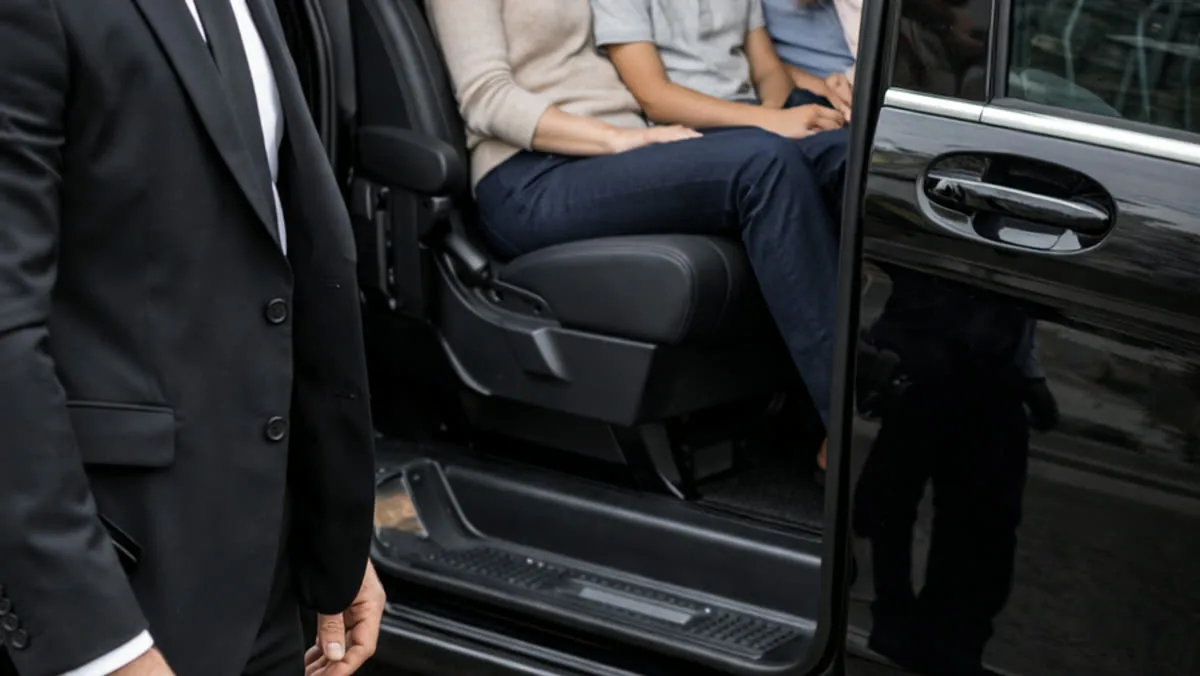
A moving vehicle is a fairly difficult target. A vehicle stopped at the kerb, with the door open and the client looking around for their phone, is a completely different matter. That is exactly why I start every transport job with the pick-up and drop-off points, not with the car's engine.
So protection in transit is not about the car. It is about what happens a few steps around it. Everything else, from technology and equipment to the number of vehicles, is built on that foundation.
Vehicle protection starts before the engine does
Vehicle security technology has moved on in recent years. Location tracking, alarms that send instant alerts to a phone, cameras recording around the vehicle and telematics that monitor how the car is being treated are now standard. All of this makes sense, and I recommend using it.
There are also systems that analyse driving behaviour and flag anything irregular: harsh braking, unusual acceleration, straying from the normal route. For company fleets, that is useful feedback. In close protection, it is more of a supplementary signal than a measure in its own right.
Likewise, biometric unlocking by fingerprint or face makes unauthorised access and key cloning harder. But that addresses vehicle theft, not a threat to the person sitting inside. The two get confused surprisingly often.
Technology watches the car, a person watches the situation
No system will tell you that the same vehicle is parked opposite the entrance again the next day at the same time. It won't tell you that the person by the restaurant door is not waiting for a taxi. Only someone who is watching, and knows what to look for, will see that.
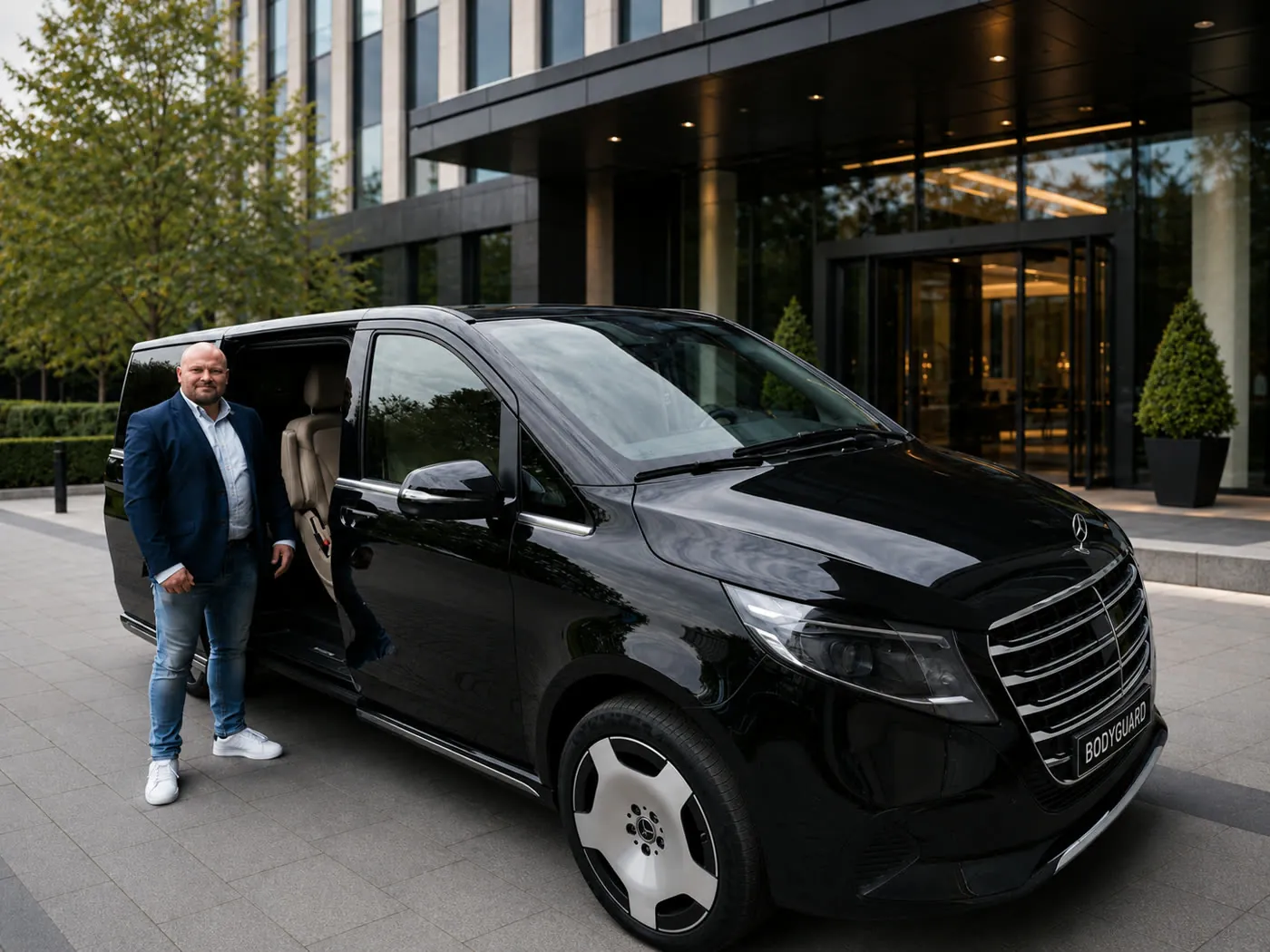
That is exactly the difference between a driver and a security driver. A security driver does not turn up at the departure time. They arrive early, drive round the area, choose a place to stop so that the client's walk from the car is short and covered, and while waiting they watch what is happening around them, not their phone.
Technology is a good aid for recording, traceability and fast alerts. But the decision whether the client should get out at that moment, or whether the car should go round the block once more, is not made by software.
Convoy escorts are mainly about planning, not speed
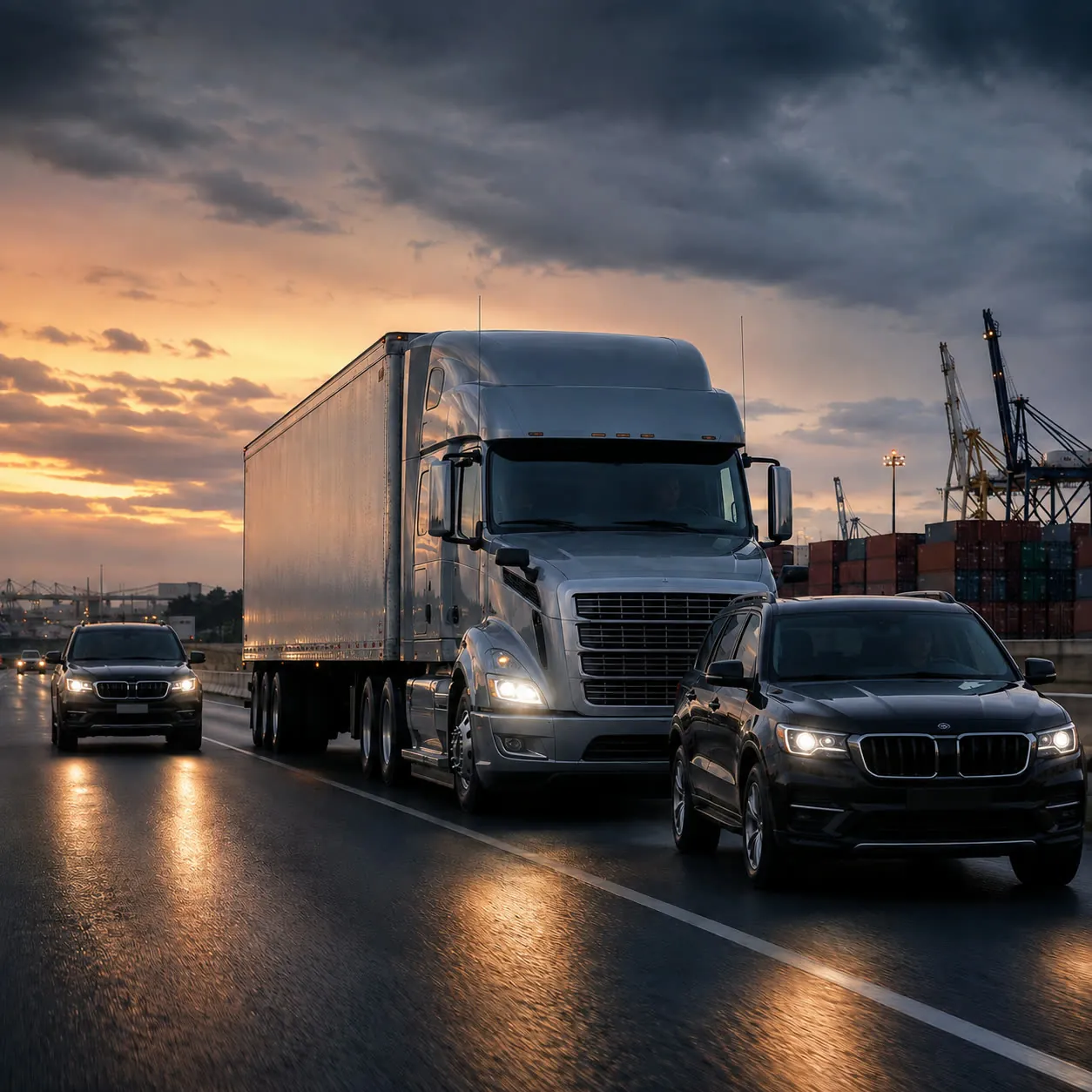
In practice, escorts are used when the cargo or passengers carry more value than on an ordinary journey: valuables, sensitive equipment, a foreign delegation, a family travelling with children. The escort vehicles have clear roles. The lead car reads the route ahead; the follow car covers the rear and keeps its distance.
Communication is essential. All vehicles must be on a single channel, using pre-agreed instructions that are short and unambiguous. When the route has to change, there is no time for explanations.
That is why, before every escort, I go through much the same checklist:
- route reconnaissance, including alternatives in case of closures or traffic jams
- identifying safe places to stop: petrol stations, car parks, locations covered by CCTV
- assigning roles between vehicles and deciding who calls a change of route
- checking communications and a backup means of contact
- an agreed procedure if the convoy gets separated
- contacts for the local authorities and knowledge of the nearest medical facilities
In air travel, the risk is on the ground, not in the air
From a security point of view, the flight itself is a fairly well-covered part of the journey. Passengers are screened before boarding and the cabin is a closed space. The situations I deal with are almost entirely around the flight.
Attention belongs at the points where the client becomes predictable: arriving at the terminal, the check-in queue, waiting in the departure hall, stepping out into an unfamiliar city. Abroad, there is also the airport transfer: the moment the client gets into a car they did not book themselves, with a driver they do not know.
The solution is unglamorous, but it has proved itself in practice. Check-in away from the main hall where possible, an escort right up to security screening, and a pick-up on the other side by a pre-vetted vehicle and driver. And a meeting point agreed in advance in case the flight is delayed or contact is lost.
A train is a public space with a fixed timetable
Rail travel has one characteristic worth noting from a security point of view: it is predictable. Anyone who knows which train you are on also knows the time and the platform. That is information worth keeping to yourself.
On the train itself, it mainly comes down to where you sit and how you behave at stops. A closed compartment is better than an open carriage, and a seat with your back to the wall and a view of the door is the basic rule. Stations where passengers get on and off see the most movement, and therefore call for the most attention.
Stations follow the same logic as airports. The risk is not the train itself but the concourse, the underpass, and the moment the client is standing on the platform with a suitcase, looking up at the departures board.
Key takeaways
Safe transport does not rest on a single element. It relies on the technology, the driver and the route plan each doing their part, with none of them counting on another to cover the rest. Cameras and location tracking provide a record and an overview. An experienced driver usually buys extra time. Good planning reduces the number of situations that would otherwise have to be handled in a hurry.
If you take one thing from this article, make it this: pay attention to the moments when you are standing still. Getting in, getting out, waiting, making connections. That is where the outcome of the whole journey is most often decided.
And a second point: predictability is a weakness. The same route at the same time, a publicly shared schedule, every booking made in your own name. None of this calls for paranoia. It is enough to vary things and not to hand over your schedule before you have to.
If you are planning regular travel, a trip abroad or a transport job you are unsure about, get in touch. We will go through the specific route together and work out what makes sense and what is unnecessary. The consultation carries no obligation, and it may well conclude that what you already have is enough.
“Safe transport isn't decided on the motorway but at the door: getting in, getting out and the moment the vehicle stands still.”— Robert Václavík