How security for a gala evening is planned before the guests arrive: VIP arrivals, accreditation, hospitality, K9, TSCM and crisis readiness.
It is seven in the evening. The first cars draw up outside the hotel, guests step out into the warm light of the entrance and a hostess checks their names. A waiter offers the first glass, music is playing in the lobby and photographers are waiting by the media wall. From the outside, the evening is just beginning.
For the security team, though, the event did not start at seven. By now the venue should already be understood, roles allocated and lines of communication working. Someone had to coordinate it all in advance: arrivals, service entrances, technical areas, the movements of VIP guests, programme changes, hotel operations and contingencies for an evening that does not go to script.
Guests often notice only the security officer at the door. Professional VIP event security, however, is a web of decisions taken much earlier. The better prepared it is, the less guests notice it during the evening. Security at a premium event should not compete with the production. It should become its invisible infrastructure.
The event does not begin when the doors open
A security plan cannot be lifted from the last event just because it is being held in the same hotel. The same ballroom might host a private dinner for a company’s leadership one evening and, the next, a well-known public figure, an international delegation or a brand attracting intense media attention. The venue stays the same; the context does not.
The starting point is a risk assessment for this specific event: the nature of the occasion, the expected number and profile of guests, how open or private it is, which VIPs will attend, the current risk environment, the timetable and onward movements. The point is not to produce the longest possible list of threats. It is to work out what really matters on the night, which measures will have a proportionate effect and who is responsible for each one.[10][14]
The “48 hours” in the headline is an illustrative concept, not a universal rule. A small private function may need less preparation; a complex gala, diplomatic gathering or multi-day programme may require weeks. What matters is not the number, but the point at which security can still be woven naturally into the production instead of being bolted onto a finished programme at the last moment.
2 AdvanceFirst, understand the venue
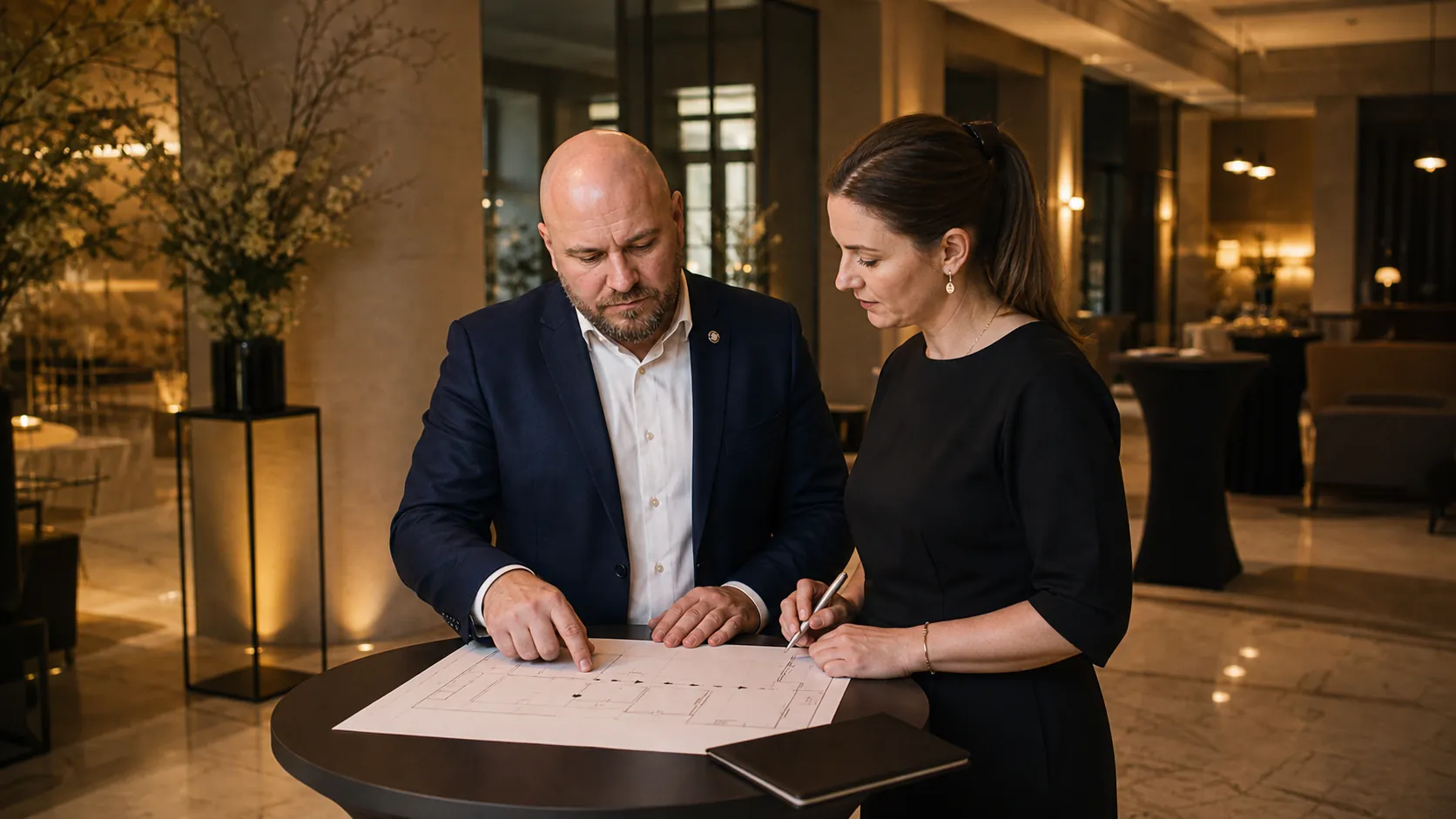
The advance visit to the venue is not a social call. It is the moment when a floor plan and a timetable turn into an operational picture. The team needs to understand the main zones, vehicle approaches, parking, entrances, back-of-house and technical areas, deliveries, capacity, safe ways out and the rules the venue normally works to.
Communication with venue management matters just as much. A hotel, gallery or private residence has its own staff, fire-safety arrangements, operational constraints and managers in charge. An external security team should not override these systems; it has to connect with them. This is where it becomes clear who controls the running of the building, who leads the production and who takes on security coordination for the event.[13]
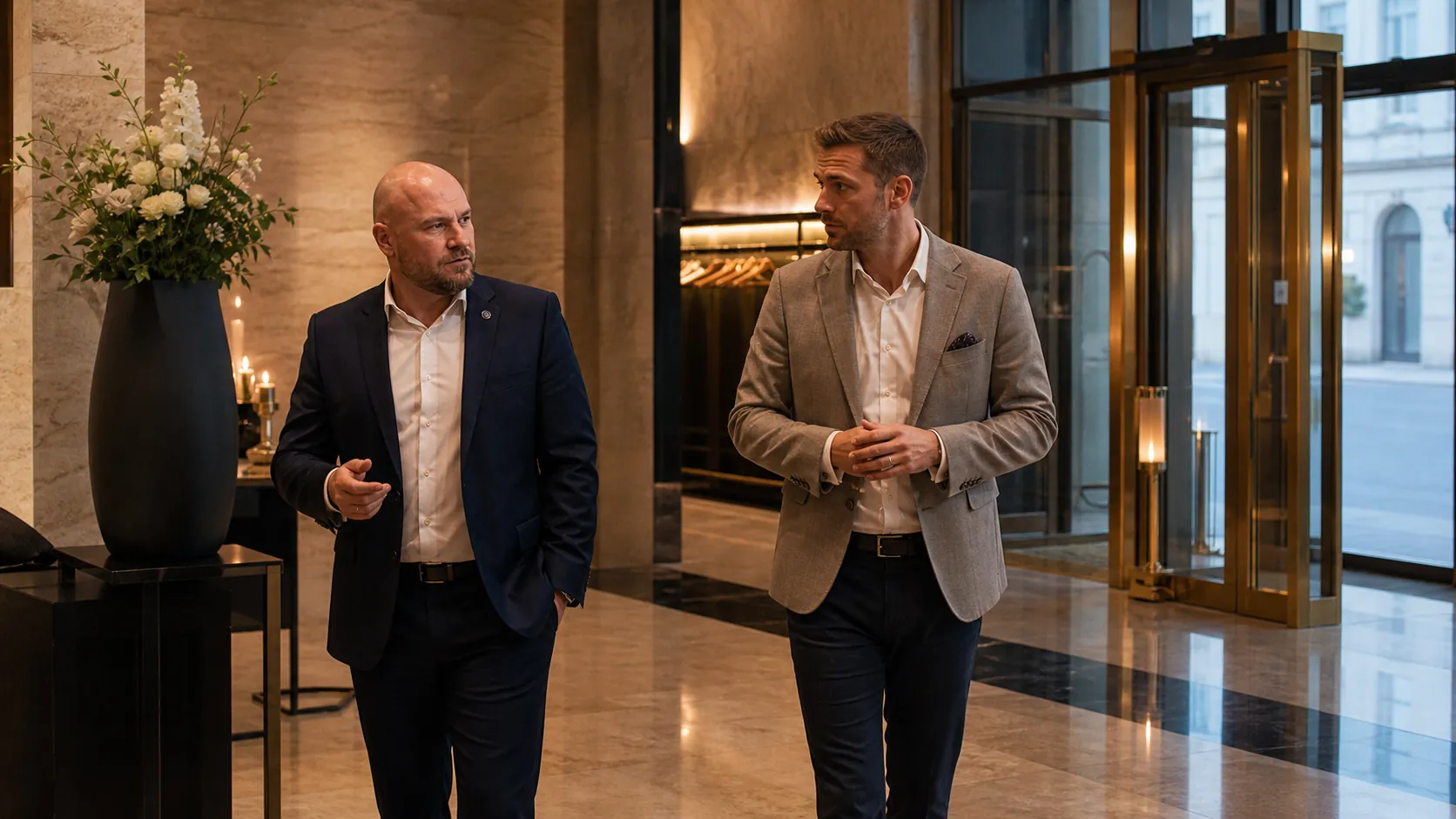
The outcome of the advance should not be a catalogue of weak points. It should be a clear plan of zones, responsibilities and lines of communication that lets every team work from the same picture. Specific tactical positions, response times and other sensitive details are not made public.
3 LogisticsGuests are not the only people at an event
Dozens of people pass through the venue before the first guest arrives: caterers, technicians, decorators, production crews, photographers, musicians, drivers, cleaners, service companies and other external staff. The point is not to treat every supplier as a threat. It is to manage legitimate access in an environment that changes quickly during the build-up.
Security therefore has to understand the logistics chain. Who is arriving, in what role, which part of the venue do they need to enter, who is their contact and when does their work finish? A supplier who legitimately needs back-of-house access during the load-in may have no reason to be there once the doors open. Clear rules protect both the event and the suppliers themselves from avoidable misunderstandings.
It works best when production, the venue and security are not competing for the space but sharing the schedule and every change to it. Security then stops being a brake on production. Instead, it heads off situations that would otherwise have to be improvised at the worst possible moment.[11]
4 AccreditationA guest list is more than a list of names
Accreditation is often treated as an administrative detail. In reality, it is a decision-making system. Invitations, plus-ones, VIP arrivals, media, staff, production access and last-minute changes must all come together in one consistent source of information.
So the key question is not only “Who is on the list?” but also “Who is allowed to change it?” If anyone can send in a change through several different channels, the check at the door soon turns into a negotiation. A professional system names the people authorised to make changes, sets an agreed route for passing them on and fixes the point from which the hostess, production and security all see the same update.
None of this means rigidity. A VIP event has to be able to absorb a legitimate change without making an unnecessary scene in front of a guest. The difference is that the change is managed, with a clear source and a clear owner. The guest then sees courteous communication, not a system trying to work out whose instruction actually counts.
What is settled before the first guest arrives
- Assessment of the event and the current risk environment
- Coordination with the venue and key suppliers
- Division of responsibilities between production, the hotel and security
- Access and accreditation arrangements
- VIP logistics, arrivals and departures
- Crisis readiness matched to the type of event
- Lines of communication and rules for approving changes
Event security and close protection are not the same
Event security protects the event’s operations, the venue, access control, good order and the guests as a whole. Close / Executive Protection centres on one protected person: their programme, their movements and their individual risk profile. Both can run side by side at the same gala, but they are not interchangeable.
The event team may keep an overview of the room and the flow of guests, while the protection team looks after one person’s needs from arrival to departure. Problems start when each team works from a different version of the schedule, does not know the other’s point of contact, or a change to the programme reaches only one of them.
That is why cooperation has to be agreed in advance. Not everyone needs to know every sensitive detail. Each team needs the information that affects its own task, and must know whom to pass a change to. An event may have several layers of protection, but from the outside it should look like one calm, well-run system.
6 MobilityVIP arrivals and departures
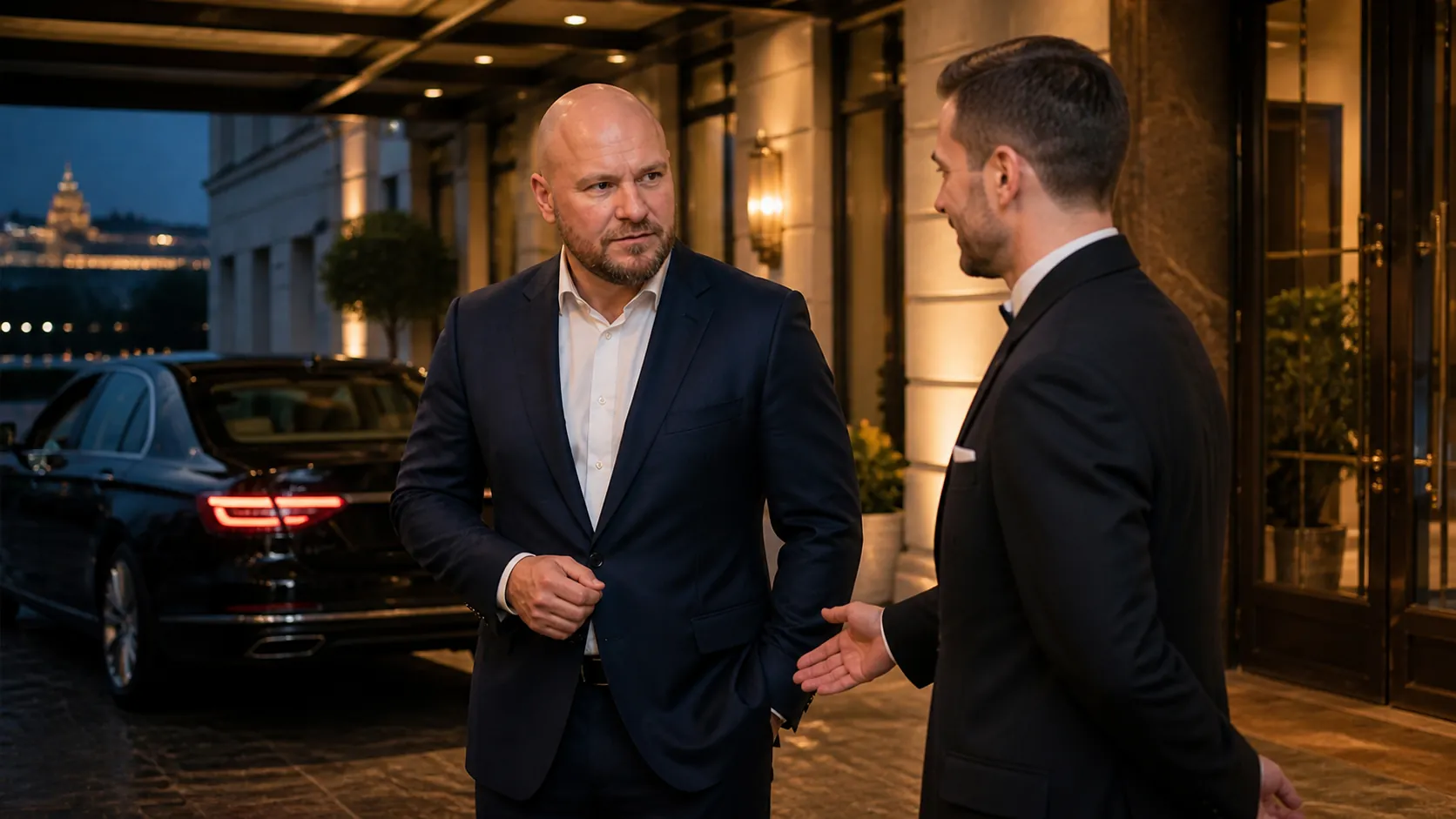
Protecting a VIP guest does not start in the ballroom. The arrival brings together transport, the hotel, production, the driver, close protection and event security. The departure can be just as sensitive: the programme often loosens, guests change their plans and several cars may need to come and go through a tight space.
Good coordination aligns timing, the handover point, contact between driver and team, movement through the building and any onward programme. The client should not have to work out who is waiting outside the hotel or whom to tell about a ten-minute delay. The information should reach the right people before a small change becomes an operational problem.
This is where VIP Transportation Services and Executive Protection connect naturally. The vehicle is not an isolated booking, and the protection team is not an isolated escort. Both are links in one chain designed to move the guest safely and discreetly from one part of the programme to the next.
7 Five-star standardSecurity has to work hand in hand with hospitality
A premium guest does not want to feel they are walking into a prison or through airport security. Yet they expect someone to be protecting their privacy, their time and their comfort. Security and first-class service are therefore not opposites. At the highest level, each must reinforce the other.
A professional speaks naturally, politely and briefly. They can check a guest’s entitlement without embarrassing them, explain a minor complication without escalating it and blend into a five-star hotel. A suit on its own is not enough. What counts is tone of voice, the way information is handled, respect for the hotel staff and the ability to deal with a problem out of other guests’ sight.
Protection done well can become part of the hospitality experience. The guest notices that the door opens at the right moment, the car is waiting, reception has been briefed and the programme flows. What they do not see is the chain of coordination that created that feeling. This discretion is a mark of quality, not a sign that no work was done.[6]
Security and first-class service are not opposites. Protection done well can become part of the hospitality experience.8 Proportionality
K9, TSCM and other layers are not automatic
Layered protection does not mean adding every available service to every event. A K9 team, a TSCM Protective Sweep, close protection, secure transport or enhanced operational support makes sense only when it matches the specific risk, venue and programme.
K9 may be relevant for a preventive search defined in advance, TSCM for confidential meetings or sensitive rooms, Executive Protection for a specific person and VIP transport to keep the programme moving safely from venue to venue. A professional proposal is just as clear about what is not needed.
Proportionality protects the budget, the atmosphere and the credibility of the whole operation. A measure without a clear purpose can complicate logistics and create a false sense of security. Every layer should have a specific reason, a defined owner and a link to the rest of the plan.
9 AdaptationWhat happens when the plan changes during the evening
An event is a living thing. An arrival runs late, an extra guest turns up, a performance is moved, transport changes or the main VIP decides to move on somewhere else. A plan that works only if the original timetable is followed to the minute is not a plan for a real event.
A resilient system therefore has rules for managing change safely. Who can approve it? Who must be told? Which teams need the full picture, and which need only a short operational update? The answers must be agreed before any change actually happens.
The greatest risk is often not the change itself but several competing versions of reality. Production is working to a new time, the driver to the old location and the door to the original list. A single point of contact and a disciplined flow of information hold the operation together without burdening the client with internal coordination.
10 ReadinessCrisis readiness
A medical emergency, a fire, a technical failure, aggressive behaviour, an unexpected crowd or any other incident relevant to the type of event is not mentioned here to cause alarm. It belongs in the preparation so that, if something happens, the team is not starting from scratch.
Crisis readiness means knowing who is responsible, how communication will flow, what the venue’s rules are and how the team links up with the emergency services. A useful plan sets out who recognises an incident, who decides on the running of the event, who speaks to the guests and who passes verified information on. The specific procedures are always adapted to the venue, the type of event and the building’s current documentation.[15][16]
The Czech Ministry of the Interior’s guidance on protecting soft targets stresses prepared plans, clear roles and coordination. International event-safety guidance likewise builds on risk assessment, audience profile, venue suitability, communication and continuous monitoring. The point is not a dramatic scenario but the ability to act quickly on decisions already taken.[8][9][10]
A verified, anonymised caseFrom landing in Prague to the evening event
A published Bodyguard Group® case study describes an evening in Prague for an internationally famous figure: arrival at the airport, the hotel, a public red-carpet event, photographers and fans. The attention could not be removed, nor was that desirable, because it was part of the programme. The task was to bring transport, close protection and the event operation together so that the guest could meet the public safely without losing control of timing and movement.
According to the study, the programme ran to plan and the protection team did not appear in any footage from the event. What matters for this article is not the operational detail. The result did not come from one visible intervention on the red carpet; it came from continuity between the arrival, the hotel, transport, the venue and a team working from one shared programme. That is what security looks like when it becomes the infrastructure of the experience.[7]
This case is taken from a published, anonymised Bodyguard Group® case study. Routes, the exact positions of individuals and other sensitive operational details are deliberately left out. 11 OutcomeA successful security operation may end without a single “intervention”
In films, the bodyguard becomes visible at the moment of conflict. In professional security, success may look exactly the opposite: a potential problem is identified early, the guest notices nothing, the programme continues and security does not disturb the atmosphere.
The evening draws to a close. Guests drift away, the photographers pack up their kit and the hotel goes back to business as usual. The principal client may never know how many times the information changed during the evening, how many people had to agree the next step or which small complication was dealt with out of their sight. All they know is that everything worked.
That is the whole point of premium event security. It does not manufacture a sense of danger or steal the show. It creates the conditions in which the organiser can host, the hotel can look after its guests, the VIP can follow their programme and the guests go home remembering the evening, not the security operation.
FAQFrequently asked questions
How far in advance should event security be planned?
There is no universal lead time. A small private function may need less preparation; a complex gala, delegation or multi-day programme may require weeks. The earlier security is involved, the more naturally it can be integrated with the venue, production and transport without late changes to the programme.
What is the difference between event security and a bodyguard?
Event security protects the event’s operations, the venue, access control and the guests as a whole. A bodyguard working in Close / Executive Protection protects one specific person and their movements. Both can operate at the same event, and they need agreed arrangements for working together.
Does every guest have to be screened?
How thorough the checks are depends on the risk assessment, the nature of the event, the venue’s rules and the client’s requirements. Not every occasion calls for the same level of checks. What matters is that whatever approach is chosen is consistent, proportionate and communicated with tact.
When is a K9 team used?
A K9 team is deployed when it has a clear preventive or detection purpose for the particular venue and risk. It is not decoration at the entrance. The deployment is planned with a defined scope and clear rules for how the area is managed afterwards.
Can event security be combined with VIP transport?
Yes. In a VIP programme, transport is often a natural part of the protective chain. The driver, event team, hotel and close protection need compatible timings and one clear point of contact.
How is a well-known person protected at a private party?
It depends on the person’s profile, the level of public attention, the guest list, the venue and the onward programme. Close protection is combined with event security so that the protected person does not have to be isolated from the occasion unless the risk requires it.
Can professional security genuinely be discreet?
Yes. Discretion does not mean passivity. It is the result of preparation, polished conduct, good communication and the ability to resolve most operational issues before they become visible to guests.
Security that supports the entire experience
If you are planning a private, corporate or VIP event and want security to be part of the overall experience rather than a visible add-on at the door, Bodyguard Group® can review your preparations discreetly while the event is still at the planning stage.
Plan your VIP event security ResearchVerified sources and reference material
- Bodyguard Group® — VIP Event Security Prague.
- Bodyguard Group® — Executive Protection Prague.
- Bodyguard Group® — VIP Transportation Services Prague.
- Bodyguard Group® — K9 Services Prague.
- Bodyguard Group® — TSCM Protective Sweep Prague.
- Bodyguard Group® — Hospitality and discreet protection in five-star hotels.
- Bodyguard Group® — anonymised case studies.
- Czech Ministry of the Interior — Protection of soft targets.
- Czech Ministry of the Interior — new guidelines on protecting soft targets.
- UK Health and Safety Executive — Assess crowd safety risks and identify hazards.
- UK Health and Safety Executive — Managing an event.
- UK Health and Safety Executive — Put crowd controls in place.
- UK National Protective Security Authority — Venues, Events & Public Spaces.
- ISO 31000:2018 — Risk management — Guidelines.
- ISO 22320:2018 — Security and resilience — Emergency management — Guidelines for incident management.
- Fire Rescue Service of the Czech Republic — Evacuation of the population.
Please note: the specific legal, fire-safety, operational and notification obligations depend on the type of event, the venue, its capacity, the programme and local conditions. This article is an expert editorial overview of principles, not a universal legal or tactical manual.