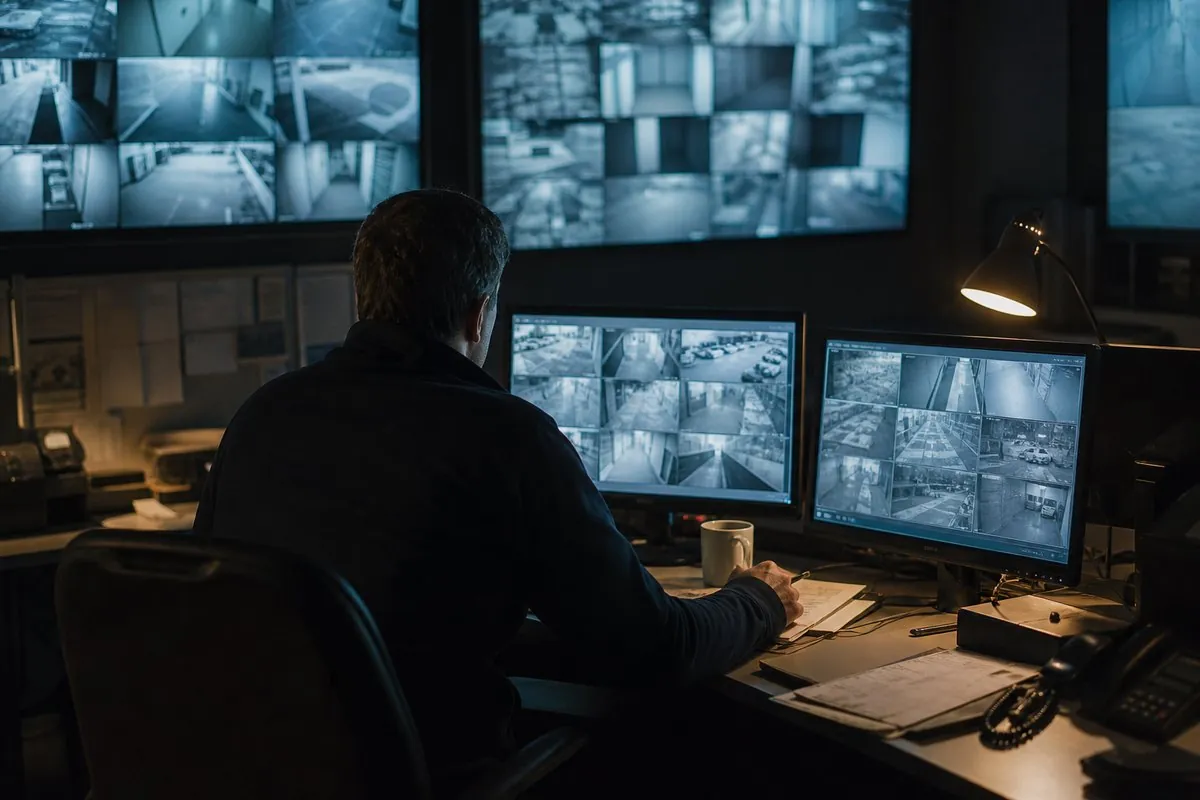
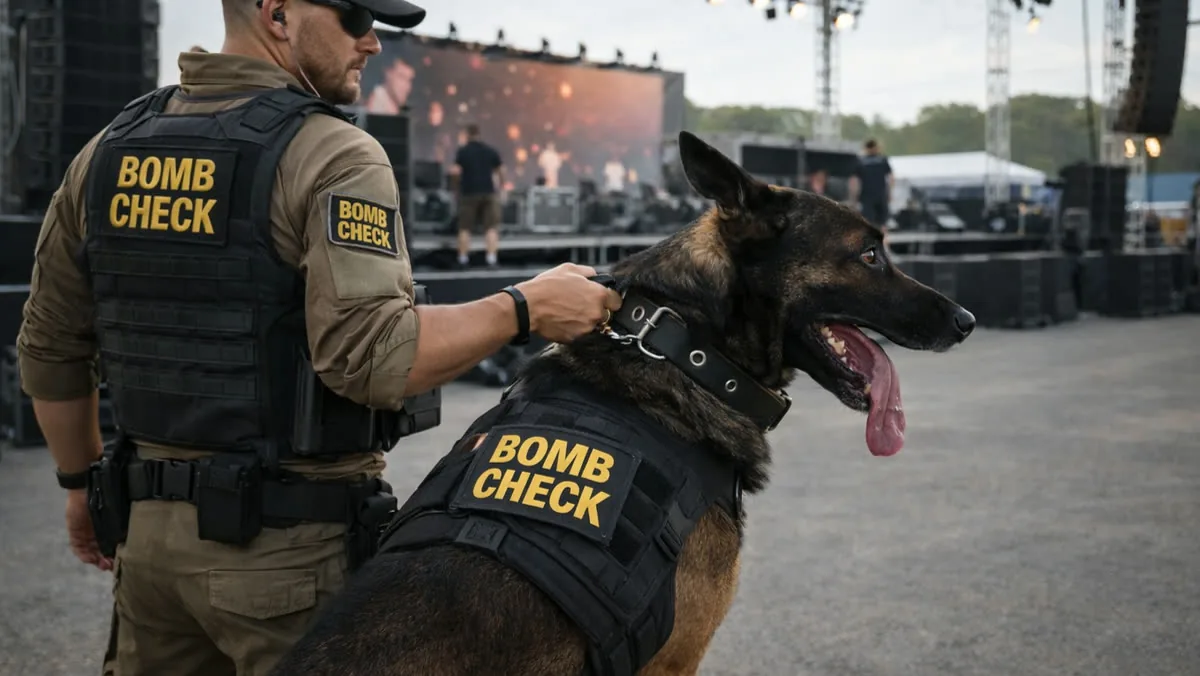
Most of the calls I deal with about business premises don't come in during working hours. They come at night, at weekends or over public holidays, exactly when there are the fewest people on site. Here I explain what round-the-clock monitoring actually does, where its limits lie and how to tell whether it has been set up properly.
Nobody was watching the warehouse, because “nothing was happening”
I've made my living protecting people and property for many years, and one scenario keeps recurring in different forms. A company has a working CCTV system, an alarm linked to a monitoring centre and keys held by the site manager. Everything looks fine until something happens one night and it turns out that the cameras were recording, but nobody was watching.
The next morning brings a phone call about three things at once: what actually happened, who was supposed to deal with it and why nobody found out sooner. By then there is usually nothing left to save, only to document. That is exactly the difference round-the-clock monitoring makes. The point isn't to have footage; it's to have someone watching right now.
And business premises aren't just a building. They are a warehouse full of stock, a server room, equipment, a vehicle fleet, documents and often people on the night shift. Each has a different risk and a different time when it is most vulnerable.
Risk doesn't keep your office hours
A site is usually most at risk when there are the fewest eyes on it. That means nights, weekends, public holidays, company-wide shutdowns, and periods when operations are moving or building work is under way and outsiders are walking through the site for legitimate reasons.
Protection that only operates during working hours therefore covers the lowest-risk window. The rest of the time it relies on the equipment raising an alert and someone answering. That isn't a security measure. It's hope.
Round-the-clock monitoring narrows that gap. Suspicious activity can be caught as it happens, not pieced together afterwards from the traces it leaves. The difference between “someone is moving near the fence” and “stock is missing this morning” is the whole point of the service.
What “immediate intervention” means in practice
The word immediately appears in a lot of proposals, but it's rarely spelled out. In reality it's a sequence of steps that has to be agreed in advance, because at night there's no time to agree anything. If any one of the steps is missing, the chain breaks.
It most often breaks at verification and contacts: the security officer has no one to call, or calls a number nobody answers. The full sequence looks like this:
- Detection: equipment or a person picks up movement, something being opened or a breach of the perimeter.
- Verification: the operator checks the location on camera or sends a patrol, and decides whether it is a genuine breach.
- Decision: the procedure depends on the type of event. A break-in is handled one way, a fire another, and an employee who has come back for a forgotten phone differently again.
- Intervention: a response unit is dispatched, or the Czech police or the fire service are called.
- Notification: your designated contact should hear about the event straight away, not the next morning.
- Documentation: the event leaves a written record and footage that can be used both with the insurer and to put the underlying cause right.
False alarms cost more than you might think
A false alarm doesn't just cost a callout. It costs trust. When a system keeps raising false alarms, people get used to it and stop responding with full seriousness. That is exactly when a real one can slip through.
False alarms usually have a trivial cause: a sensor set too sensitive, an animal on the site, a tarpaulin flapping in the wind, an employee who wasn't given the right code. Better equipment won't fix that. What fixes it is someone who assesses every event and keeps fine-tuning the settings.
That's why it pays to have a permanent team of operators who know your operation. They know that loading routinely happens on Friday evenings and won't send out a unit because of it. But they will notice when loading runs longer than usual, and they'll check.
The camera sees, but a person decides
Technology has advanced considerably in recent years and can now handle detection that once needed more people. But technology doesn't decide. It can't reliably read intent, it doesn't weigh up context and it doesn't take responsibility.
The solutions I see working best for clients combine both: cameras and sensors as the senses, a monitoring centre as the brain, and manned guarding or a response unit as the hands. Each part on its own is weaker than it should be.
For smaller sites, that may mean remote monitoring and a rapid response. Production sites or premises with sensitive equipment usually can't do without a permanent human presence. Which model suits you can only be judged from how your operation actually runs, not from a catalogue.
Always ask who is watching the screens and what they will do the moment something happens. That is the question that separates monitoring from mere recording.
How to recognise monitoring that actually works
When you're getting a quote, go through the questions below with the supplier. There's nothing sophisticated about them, but they show fairly reliably whether there's a well-thought-out system behind the quote or just an invoice.
If you get specific answers to every point, you have something you can work with. If the answers stay vague, I'd recommend asking again until they become specific.
- Who exactly staffs the monitoring at night and on public holidays, and is it always the same group of people who know your site?
- What is the procedure for each type of event, and do you have it in writing?
- Who is the contact person on your side, and is there a backup contact?
- How quickly can the response unit realistically reach your site from its base?
- How are repeated false alarms dealt with, and who assesses them?
- After an event, will you receive a written report and footage in a form you can pass to your insurer?
- Who holds the keys, codes and access rights, and how does that change when an employee leaves?
Key takeaways
Round-the-clock monitoring isn't about something happening every night. Most nights are quiet, and that's fine. What you're paying for is the one night that isn't: someone notices, checks and acts, without you even needing to know about it.
In practice that means three things. Damage can often be stopped before it grows. You don't have to make decisions alone, at night, without information. And your team can concentrate on its work, not on security.
If you already have cameras and an alarm but can't say who watches them at night, I'd start there. It isn't about replacing equipment, but about adding the missing link. The right set-up then depends on what is most sensitive on your site and when it has the fewest people around.
If you'd like to go through your current set-up with me, with no obligation, get in touch. We'll walk round the site together, I'll tell you where I see weak points, and then it's up to you whether you want to do anything about them. I treat every enquiry in confidence and won't push you into anything.
“Round-the-clock monitoring doesn't pay off every night. It pays off on the one night when someone needs to notice in time.”— Robert Václavík