In close protection, you can't tell who trains and who doesn't until a situation puts it to the test. This is what bodyguard training with me really looks like, what it involves and why it never stops, described exactly as it works in practice.
The best evening is one with nothing to report
A typical escort from a social event looks uneventful. The client heads for the car, a small crowd gathers by the exit, and one person comes in faster and closer than is comfortable. A colleague shifts his weight and changes angle, I steer the client two steps to the side, and we carry on. The whole thing takes a few seconds.
The client usually remembers an evening like that as a quiet one where nothing happened. That's exactly what I want to hear. But the three movements that kept the evening quiet aren't invented on the spot. They come from training, where the same route through a crowd is repeated so many times that it stops being a decision and becomes a habit.
When clients ask me what they are actually paying for, this is the answer. They're not paying for a figure by the door. They're paying for the fact that, when a reaction is needed, nobody on the team has to think about what to do.
Routine looks boring, and that is exactly why it works
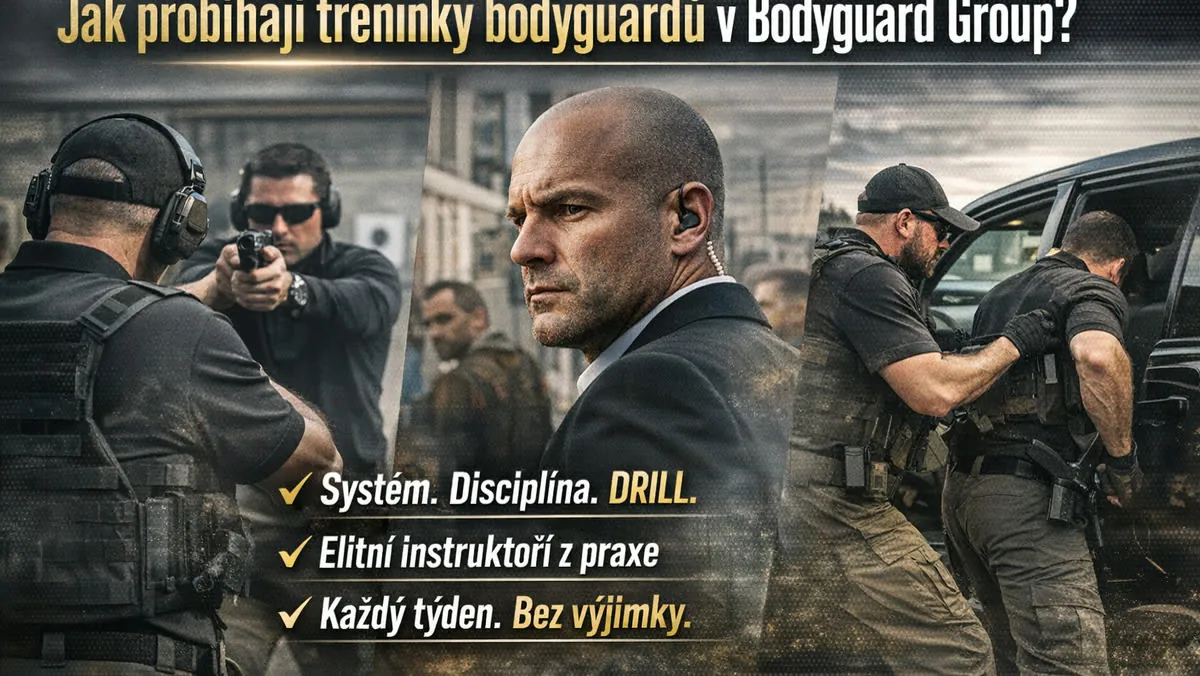
Training with me runs on a regular schedule, not in a rush before a big assignment. It is led by instructors with hands-on close protection experience, so every session brings in things that weren't dreamt up in a classroom. Each session has a set scenario and a specific goal. It is not a group of people getting together for a workout.
The reason is simple. Under pressure, people don't come up with new solutions. They sink to the level of their training. When habits are fresh, the reaction comes before fear has a chance to block it. When they have gone stale, it comes too late or out of proportion.
Close protection skills also have a short shelf life. Settings change, the way people behave in crowds changes, and so does the typical event I accompany a client to. That's why I treat regular training as part of day-to-day operations, not as a perk. Every team member must therefore:
You don't recognise a professional by their appearance or their kit. You recognise them by the habits that stay with them when they're tired and the situation is starting to fall apart.
- maintain physical and mental readiness
- undergo regular tactical training
- refine communication and decision-making under pressure
- work on team coordination
Covert protection stands or falls on where you stand
Most of my work is low-profile, and it is meant to stay that way. The client goes to a meeting, a dinner, a hotel lobby or the airport, and shouldn't become the centre of attention because of the people with them. That's why positioning and cover take up most of the training time: who holds which side, who enters an unfamiliar space first, who stays with the vehicle.
The most common mistake I see in inexperienced people is wanting to be seen. A show of strength deters no one, but it reliably tells everyone nearby that this person is worth watching. Covert protection does the opposite: it lets the client look as though they're walking alone.
So I train the team to escort through different environments, because each one has its own rules. A narrow corridor, a revolving door, a multi-storey car park, a packed reception, a railway platform: in each one the distances change, as do the ways out and who on the team takes the lead. The transitions between these situations are where mistakes happen most often, so we run them again and again.
Reading the space before anything happens
Situational awareness is a phrase used a lot in this business, and it usually means nothing. In practice, it is the ability to notice that something isn't behaving like everything around it: a person moving against the flow, a vehicle you've now seen twice today, a hand that stays in a pocket longer than makes sense.
This can only be learnt through repetition. So in training I work on recognising risky behaviour, spotting threats in a crowd and counter-surveillance. Some colleagues are given the job of watching, and the others have to spot them without letting on that they have.
The other half of this work happens before the client even leaves home. Good preparation usually achieves more than any intervention, which is why before an assignment I go through:
- primary and alternative routes for every move
- escape points and safe havens along the entire route
- the security of the principal's home and workplace
- venues for meetings and appointments, business and private
- scenarios for when the plan falls apart
A calm voice is often the first line of defence
A bodyguard isn't just a physical barrier. They are also a filter between the client and the outside world: fielding questions, turning away unwelcome approaches, dealing with staff, reception and event organisers. Most situations are settled with a word and a calm tone long before hands would come into it.
That's why crisis communication is a strand of training in its own right. In training I cover de-escalation, dealing with someone who is drunk or aggressive, and communicating when your pulse is racing. Roles rotate: whoever plays the aggressor today calms one down tomorrow, because each side teaches you something different.
It also includes working with the police and the other emergency services. A bodyguard doesn't replace the state and has no ambition to deal with things alone. Being able to hand over clearly what happened, who is who and what we need is as much part of the standard as anything else.
An intervention that still holds up the next day
Physical preparation and self-defence are always part of training, but not in the role people imagine. I don't train for fights. I train three things: defence in confined spaces such as beside a car, in a lift or in a narrow corridor; protecting a third person; and controlling an attacker without excessive force.
The key word is proportionality. An intervention has to stand up not only in the moment but the next day, when someone reviews it. That's why in training I take the limits of the law as seriously as technique. To me, the client's safety and the lawfulness of what we do are two sides of the same coin.
The last piece of the puzzle is the team. Close protection is not a solo discipline, and even an excellent individual is no use without teamwork. With the team I drill signals and non-verbal communication, handing over responsibility on the move, reacting to a changing situation in real time, and coordinating with drivers and logistics. The aim is for the team to understand each other without words, because when it matters there is rarely time for them.
Key takeaways
You can't judge the quality of protection by what you saw. It is judged by what didn't happen, and that is something a client commissions in advance and can only assess afterwards. The one thing you can assess beforehand is the preparation of the people who will be there.
Whoever you talk to about close protection, ask specific questions:
The answers will tell you more about a protection company than any presentation. I don't see training as an add-on to the job but as a precondition. Without regular training I wouldn't take on an assignment, because I couldn't vouch for the team's work.
If you're considering protection for yourself, your family or your company and aren't sure what you actually need, get in touch. I'll look at your situation with no obligation and tell you what makes sense, even if the conclusion is that you don't need a permanent escort for now.
- how often the team trains and what the training actually involves
- who leads the training and what experience they have
- whether communication and de-escalation are trained too, not just the physical side
- how the team approaches proportionality and the lawfulness of its actions
- how route planning and preparation work before an assignment
“Under pressure, nobody invents new solutions. You sink to the level of your training.”— Robert Václavík